
lotus labs
AI-Powered Updates Coming Soon to Your Favorite Apps



Slack: SlackGPT
SlackGPT is a new chatbot for Slack that can help users with a variety of tasks, such as finding information, scheduling meetings, and generating creative content. Powered by OpenAI's GPT-3 language model, SlackGPT will help you work smarter, learn faster, and communicate better. Each time you log in, you will be able to quickly get up to speed with one click as the AI technology can summarize all of a channel’s unread messages into a brief summary. SlackGPT also has the ability to automate emails or messages based on the audience further increasing daily productivity. Additionally, with AI assistance built natively into Slack’s message composer and canvas, Slack GPT can also help you tweak your drafts until perfection. With a few clicks, you can create content or adjust the tone at any point in your writing with options to shorten, elaborate, or change the tone.
Grammarly: GrammarlyGO
GrammarlyGO is a new mobile app available for iOS and Android devices that uses AI to help users with grammar, spelling, and punctuation. GrammarlyGO brings the power of generative AI to the Grammarly experience, providing assistance across the digital spaces you write in most. There are a variety of ways to use GrammarlyGO as it can keep track of the context of your writing as well as your preferred writing style while offering suggestions. You can accelerate your writing process by prompting GrammarlyGO with basic instructions to conceive polished drafts. You can simplify rewriting by inputting your written text into GrammarlyGO and letting the app offer different versions of your original ideas. Finally, you can facilitate brainstorming as GrammarlyGO can generate any idea or structure straight to the page you are already on. While users will be able to input 100 prompts per month into GrammarlyGO for free, they will need the premium version for more monthly inputs.
Zoom: ZoomIQ
The purpose of Zoom IQ is to be a smart companion that empowers collaboration and unlocks people’s potential by summarizing chat threads, organizing ideas, drafting content for chats, emails, and whiteboard sessions, and creating meeting agendas. As a result, this AI- add-on has many notable features such as being able to analyze meeting recordings and provide insights into how meetings are being run. This information can then be used to improve meeting performance and productivity. If you have to join a Zoom meeting late, you can simply ask Zoom IQ to summarize what you have missed in real-time and even ask further questions. If you need to create a whiteboard session for your meeting, Zoom IQ can generate it based on text prompts. If you need an additional perspective for a Zoom chat, you can use Zoom IQ to compose messages based on the conversational context. With its new AI innovations, Zoom appears to be poised for further growth.

Discover 3 AI tools that are useful for any professional including those for productivity automation and data analysis
65e0e1dcb09181168356dc07
lotus labs
© 2026 LOTUSLABS All rights reserved.


AI-Powered Updates Coming Soon to Your Favorite Apps
Slack: SlackGPT
SlackGPT is a new chatbot for Slack that can help users with a variety of tasks, such as finding information, scheduling meetings, and generating creative content. Powered by OpenAI's GPT-3 language model, SlackGPT will help you work smarter, learn faster, and communicate better. Each time you log in, you will be able to quickly get up to speed with one click as the AI technology can summarize all of a channel’s unread messages into a brief summary. SlackGPT also has the ability to automate emails or messages based on the audience further increasing daily productivity. Additionally, with AI assistance built natively into Slack’s message composer and canvas, Slack GPT can also help you tweak your drafts until perfection. With a few clicks, you can create content or adjust the tone at any point in your writing with options to shorten, elaborate, or change the tone.
Grammarly: GrammarlyGO
GrammarlyGO is a new mobile app available for iOS and Android devices that uses AI to help users with grammar, spelling, and punctuation. GrammarlyGO brings the power of generative AI to the Grammarly experience, providing assistance across the digital spaces you write in most. There are a variety of ways to use GrammarlyGO as it can keep track of the context of your writing as well as your preferred writing style while offering suggestions. You can accelerate your writing process by prompting GrammarlyGO with basic instructions to conceive polished drafts. You can simplify rewriting by inputting your written text into GrammarlyGO and letting the app offer different versions of your original ideas. Finally, you can facilitate brainstorming as GrammarlyGO can generate any idea or structure straight to the page you are already on. While users will be able to input 100 prompts per month into GrammarlyGO for free, they will need the premium version for more monthly inputs.
Zoom: ZoomIQ
The purpose of Zoom IQ is to be a smart companion that empowers collaboration and unlocks people’s potential by summarizing chat threads, organizing ideas, drafting content for chats, emails, and whiteboard sessions, and creating meeting agendas. As a result, this AI- add-on has many notable features such as being able to analyze meeting recordings and provide insights into how meetings are being run. This information can then be used to improve meeting performance and productivity. If you have to join a Zoom meeting late, you can simply ask Zoom IQ to summarize what you have missed in real-time and even ask further questions. If you need to create a whiteboard session for your meeting, Zoom IQ can generate it based on text prompts. If you need an additional perspective for a Zoom chat, you can use Zoom IQ to compose messages based on the conversational context. With its new AI innovations, Zoom appears to be poised for further growth.
Get ready for AI-powered updates coming soon to your favorite apps with enhanced features smarter recommendations and improved user experiences
65e0e1dcb09181168356dc08
lotus labs
© 2026 LOTUSLABS All rights reserved.


A simple guide to understand AI agents

According to a Gartner survey and industry trends, there is no doubt that we are in the era of AI evolution. AI agents are at the forefront of recent developments. Their ability to handle complex tasks enables full-scale automation. They break down tasks like the human mind and address these sub-tasks in a step-by-step, appropriate manner. Industry leaders such as Nvidia, Google, Meta, and Microsoft are betting on their immense potential. Even tech-averse companies are catching up with the trend of using agents to improve their bottom line.
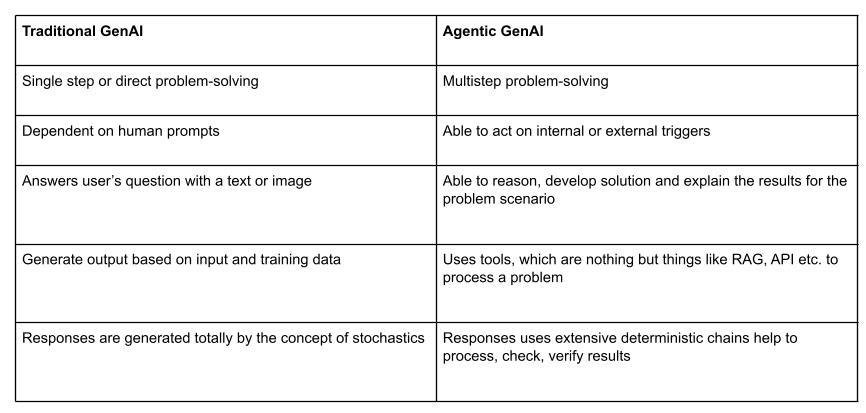
The amazing potential lies in the fact that, unlike generative AI, agents don't just respond to user input; they can process a complex problem from start to finish. For example, in a scenario where an agent has to settle a customer's general insurance claim, the agent processes the required information, such as the claim form PDF, texts associated with the claim event, images of the damaged property, terms and conditions for claim settlement, and a database containing policy information (including whether the policy is active) and other important details. It reaches out to the relevant parties for any necessary data to process the claim. Currently, AI agents are capable of doing all of this autonomously, with minimum human oversight to ensure correct processing.
Traditional gen AI vs Agentic gen AI:
End-to-End Conceptual Working of an AI Claim Settlement Agent
This describes how an AI agent tasked with settling claims breaks down its work, handling the process from initiation to claim denial or reimbursement.
1. Claim Initiation and Processing Trigger: The workflow begins when a claimant sends a message (via email or the company's app) regarding a car accident and requests reimbursement. The agent analyzes the message and recognizes the customer's intent to initiate a claim process.
2. Data Extraction: This phase is crucial for converting unstructured information into structured, actionable data for systematic and secure processing. While classification assigns text to categories, extraction identifies and retrieves specific details. Instead of simply copying data, a language model generates structured outputs. For example, it can standardize phone numbers (e.g., converting "882 55645678" to "+91 88255645678") for consistency. This structured output (e.g., JSON) is generated by combining OCR and image models (if necessary, for scanning images) with Large Language Models (LLMs) to extract the required information.
3. External Service Integration: While generative AI can answer questions using pre-trained data, fine-tuning, or Retrieval Augmented Generation (RAG), AI agents require access to real-time corporate and external databases. Critically, agents must not only read data but also write it to ensure continuity. For instance, an agent can verify a contract number in a customer database and update a claim's status in a tracking system. It can even request missing information from customers or other sources, enabling autonomous operation.
4. Assessment, RAG, Reasoning, and Confidence: Administrative tasks often involve interpreting cases based on various rules, an area where AI excels. Since providing all context (e.g., policy terms) in a single query is impractical, a vector database is used to retrieve relevant snippets—a technique known as RAG. To enhance accuracy, the AI is prompted to "think aloud" before making an assessment, similar to solving a math problem step by step. This reasoning process is beneficial in several ways:
- It provides clear explanations to customers.
- It helps engineers understand the model's errors.
- Furthermore, it ensures the model's answer is logically derived, not random.
Confidence estimation is essential for accuracy. With effective few-shot learning, models can assess their own certainty. This allows businesses to set thresholds, routing uncertain cases to human review while automating high-confidence cases for efficiency.
With the development of increasingly efficient and open-source models, AI agents are poised to become even more powerful and impactful.
To work on similar and various other AI use cases connect with us at
https://www.lotuslabs.ai/
To work on computer vision use cases get to know our product Padme
https://www.padme.ai/
A simple guide to understand AI agents
67ac79236c35399ca39bca68