lotus labs
AI-Powered Updates Coming Soon to Your Favorite Apps



Slack: SlackGPT
SlackGPT is a new chatbot for Slack that can help users with a variety of tasks, such as finding information, scheduling meetings, and generating creative content. Powered by OpenAI's GPT-3 language model, SlackGPT will help you work smarter, learn faster, and communicate better. Each time you log in, you will be able to quickly get up to speed with one click as the AI technology can summarize all of a channel’s unread messages into a brief summary. SlackGPT also has the ability to automate emails or messages based on the audience further increasing daily productivity. Additionally, with AI assistance built natively into Slack’s message composer and canvas, Slack GPT can also help you tweak your drafts until perfection. With a few clicks, you can create content or adjust the tone at any point in your writing with options to shorten, elaborate, or change the tone.
Grammarly: GrammarlyGO
GrammarlyGO is a new mobile app available for iOS and Android devices that uses AI to help users with grammar, spelling, and punctuation. GrammarlyGO brings the power of generative AI to the Grammarly experience, providing assistance across the digital spaces you write in most. There are a variety of ways to use GrammarlyGO as it can keep track of the context of your writing as well as your preferred writing style while offering suggestions. You can accelerate your writing process by prompting GrammarlyGO with basic instructions to conceive polished drafts. You can simplify rewriting by inputting your written text into GrammarlyGO and letting the app offer different versions of your original ideas. Finally, you can facilitate brainstorming as GrammarlyGO can generate any idea or structure straight to the page you are already on. While users will be able to input 100 prompts per month into GrammarlyGO for free, they will need the premium version for more monthly inputs.
Zoom: ZoomIQ
The purpose of Zoom IQ is to be a smart companion that empowers collaboration and unlocks people’s potential by summarizing chat threads, organizing ideas, drafting content for chats, emails, and whiteboard sessions, and creating meeting agendas. As a result, this AI- add-on has many notable features such as being able to analyze meeting recordings and provide insights into how meetings are being run. This information can then be used to improve meeting performance and productivity. If you have to join a Zoom meeting late, you can simply ask Zoom IQ to summarize what you have missed in real-time and even ask further questions. If you need to create a whiteboard session for your meeting, Zoom IQ can generate it based on text prompts. If you need an additional perspective for a Zoom chat, you can use Zoom IQ to compose messages based on the conversational context. With its new AI innovations, Zoom appears to be poised for further growth.
Discover 3 AI tools that are useful for any professional including those for productivity automation and data analysis
65e0e1dcb09181168356dc07
lotus labs
© 2026 LOTUSLABS All rights reserved.


AI-Powered Updates Coming Soon to Your Favorite Apps
Slack: SlackGPT
SlackGPT is a new chatbot for Slack that can help users with a variety of tasks, such as finding information, scheduling meetings, and generating creative content. Powered by OpenAI's GPT-3 language model, SlackGPT will help you work smarter, learn faster, and communicate better. Each time you log in, you will be able to quickly get up to speed with one click as the AI technology can summarize all of a channel’s unread messages into a brief summary. SlackGPT also has the ability to automate emails or messages based on the audience further increasing daily productivity. Additionally, with AI assistance built natively into Slack’s message composer and canvas, Slack GPT can also help you tweak your drafts until perfection. With a few clicks, you can create content or adjust the tone at any point in your writing with options to shorten, elaborate, or change the tone.
Grammarly: GrammarlyGO
GrammarlyGO is a new mobile app available for iOS and Android devices that uses AI to help users with grammar, spelling, and punctuation. GrammarlyGO brings the power of generative AI to the Grammarly experience, providing assistance across the digital spaces you write in most. There are a variety of ways to use GrammarlyGO as it can keep track of the context of your writing as well as your preferred writing style while offering suggestions. You can accelerate your writing process by prompting GrammarlyGO with basic instructions to conceive polished drafts. You can simplify rewriting by inputting your written text into GrammarlyGO and letting the app offer different versions of your original ideas. Finally, you can facilitate brainstorming as GrammarlyGO can generate any idea or structure straight to the page you are already on. While users will be able to input 100 prompts per month into GrammarlyGO for free, they will need the premium version for more monthly inputs.
Zoom: ZoomIQ
The purpose of Zoom IQ is to be a smart companion that empowers collaboration and unlocks people’s potential by summarizing chat threads, organizing ideas, drafting content for chats, emails, and whiteboard sessions, and creating meeting agendas. As a result, this AI- add-on has many notable features such as being able to analyze meeting recordings and provide insights into how meetings are being run. This information can then be used to improve meeting performance and productivity. If you have to join a Zoom meeting late, you can simply ask Zoom IQ to summarize what you have missed in real-time and even ask further questions. If you need to create a whiteboard session for your meeting, Zoom IQ can generate it based on text prompts. If you need an additional perspective for a Zoom chat, you can use Zoom IQ to compose messages based on the conversational context. With its new AI innovations, Zoom appears to be poised for further growth.
Get ready for AI-powered updates coming soon to your favorite apps with enhanced features smarter recommendations and improved user experiences
65e0e1dcb09181168356dc08
lotus labs
© 2026 LOTUSLABS All rights reserved.

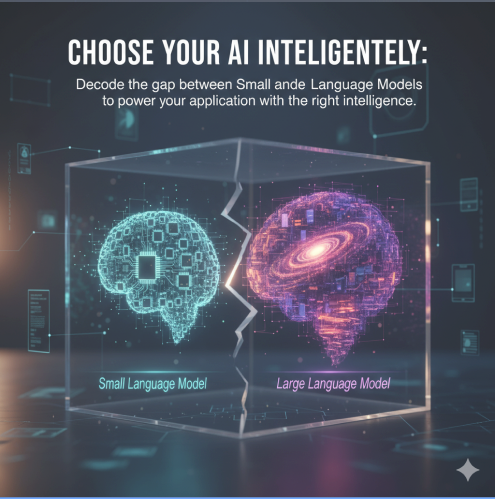
Choose your AI intelligently: Decode the gap between Small and large language models to power your application with the right intelligence.
What is a language model?
To be short yet precise, language models are derived from the study of maths, natural language processing, and deep learning. They are combined with huge amounts of data and increased computing capabilities of the modern age to derive a model that can generalize and answer user inputs based on its knowledge base, that is, its training data (at this point, almost everything available on the internet)
LLM and SLMs:
Large Language and small language models are basically neural networks; they differ in their size or parameters (which depend on the computing resources while implementing the architecture and training). LLMs are huge and have more scope to generalize, while SLMs are compact, efficient, and typically built for more targeted tasks. Generally, SLM has parameters from the range of millions to lower billions, while LLM has parameters from the range of 100 billion to trillions
Some examples:
Large Language Models (LLMs)
- GPT-4 (OpenAI) – Multimodal, high reasoning capabilities, ~1T+ parameters (exact count undisclosed)
- GPT-3.5 (OpenAI) – Fast and optimized for chat, ~175B parameters.
- LLaMA 2 70B (Meta) – Open-source, strong performance on reasoning tasks, 70B parameters.
- Claude 3 Opus (Anthropic) – Long context understanding and safe alignment-focused, ~200B+ parameters (estimated).
- PaLM 2 (Google) – Multilingual and code-capable transformer model, parameter range ~70B–540B.
- Gemini Ultra (Google DeepMind) – Advanced multimodal reasoning with a large context window, parameters in the hundreds of billions.
Small Language Models (SLMs)
- LLaMA 2 7B (Meta) – Lightweight, fine-tunable for custom tasks, 7B parameters.
- Mistral 7B (Mistral AI) – Highly efficient with sliding-window attention, 7B parameters.
- GPT-2 Small (OpenAI) – Legacy lightweight model for basic text tasks, 124M parameters.
- Phi-2 (Microsoft) – Compact with strong reasoning for its size, 2.7B parameters.
- TinyLlama 1.1B – Micro-scale transformer for edge deployments, 1.1B parameters.
- DistilBERT (Hugging Face) – Compressed BERT for classification tasks, ~66M parameters.
Pros and Cons:
LLMs The Heavyweight Champions
Why they shine:
- Built for deep reasoning, creative generation, and multi-step thought processes.
- Can understand long context windows, making them ideal for document-heavy workflows.
- Highly generalized, often performing well even without task-specific fine-tuning.
- Benefit from advanced alignment layers and safety training, reducing harmful or biased responses.
Where they struggle:
- Compute-hungry applications need dedicated GPUs and significant memory to run efficiently.
- Higher latency is not the best fit for real-time or on-device tasks.
- Cost scales quickly, especially in production-grade API usage.
- Sometimes overkill for narrow, rule-based tasks that don't require deep reasoning.
SLMs The Nimble Specialists
Why they shine:
- Lightweight and blazing fast, making them ideal for edge devices and low-latency applications, and also where data security is a priority.
- Can run on CPUs or small GPUs, unlocking private/on-prem deployments.
- Easier to fine-tune on custom datasets, allowing tight domain specialization.
- Cost-efficient both in terms of API billing and infrastructure.
Where they struggle:
- Limited reasoning depth, especially on complex or abstract prompts.
- Shorter context windows restrict them in tasks involving long documents.
- May require more prompt engineering or external logic (like RAG or rules) to stay accurate.
- Typically lack advanced safety tuning, which can be risky in user-facing systems.
Common real-world use cases:
LLMs:
LLMs are ideal when the task demands depth, reasoning, creativity, or open-ended conversation.
- Complex reasoning and decision support generating insights, strategy suggestions, or multi-step explanations.
- Long-form content generation articles, reports, marketing copy, story writing, and code documentation.
- Multimodal understanding (in newer LLMs) interprets text, images, and context together.
- Exploratory chat and brainstorming, where the user may not even know the exact query upfront.
- Advanced code generation and refactoring where logic understanding is key.
- Multi-hop question answering queries that require chaining multiple knowledge points.
Think of LLMs as generalist consultants, broad, powerful, and great for exploration and creative problem-solving.
SLMs:
SLMs are perfect for focused, repetitive, or rule-based tasks that prioritize speed, cost-efficiency, and control.
- Intent detection and classification tagging support tickets, routing customer queries.
- Entity extraction and form parsing, pulling out names, IDs, amounts, and dates from structured or semi-structured text.
- Sentiment analysis and tone detection at scale, with ultra-low latency.
- FAQ-style response generation with controlled outputs for chatbots.
- Inference at the edge or on-prem for privacy-first or offline use cases.
- Template-based content filling product descriptions, micro-copy, and email subject lines.
- Real-time translations or short summarizations where speed outweighs depth.
SLMs behave like skilled specialists, fast, reliable, and highly efficient at doing one thing extremely well.
Practical implementation:
At Lotus Labs, we were tackling two very different problems, both under the umbrella of “AI chatbots” but they could not have been more distinct in what they demanded from the technology.
For our QA chatbot, the mission was clear: “Don’t hallucinate. Don’t overthink. Just fetch the right piece of information from our product manual and respond clearly.” The knowledge base was static and structured as a goldmine of precise information that didn’t need creative interpretation, just accurate retrieval.
Instead of deploying a heavyweight model that tries to “know everything,” we chose the smarter route: an SLM-based pipeline using a sentence-transformer for embeddings. The chatbot first retrieved the most relevant chunks using semantic similarity, and only then did a lightweight generative AI layer craft a clean, human-like response. Fast, cost-effective, and hyper-focused, exactly what a documentation assistant needs to be.
The Text-to-SQL chatbot, however, lived in a different universe. Here, the system had to understand natural language, interpret intent, map it to relational database logic, and then generate syntactically valid SQL queries, all while reasoning about joins, filters, and context awareness. This wasn’t retrieval—this was a structured generation with logical constraints.
That’s why we turned to a Large Language Model. For this use case, raw computational intelligence mattered the ability to reason, infer, and construct qualities that an SLM, no matter how optimized, isn’t meant to handle at that complexity.
Check out the relevant links below for the solutions mentioned in the above few sentences
- Video analytics platform (Padme): https://www.padme.ai/
- QA chatbot for Padme: https://huggingface.co/spaces/sram77/ll-padme-chatbot (common questions: how to add, edit camera ?, how to set up people counting for my camera ?, etc.)
- Text 2 SQL chatbot (Petalytics): https://petalytics.co/
- What is Petalytics? - blog link: https://www.lotuslabs.ai/post/why-chat-with-your-data-usually-disappoints----and-how-to-make-it-enterprise-grade
Closing Remarks:
In AI, the goal isn’t to deploy the biggest model; it’s to deploy the smartest solution.
Sometimes that means unleashing a powerful LLM to reason and generate complex logic. Other times, it means letting a lean SLM whisper the right answer with speed, precision, and efficiency.
The real intelligence lies in choosing the right tool, not the heaviest one.
Choose your AI intelligently: Decode the gap between Small and large language models to power your application with the right intelligence.
6909fbe2baab1d0a32a915ec