
lotus labs
AI-Powered Updates Coming Soon to Your Favorite Apps



Slack: SlackGPT
SlackGPT is a new chatbot for Slack that can help users with a variety of tasks, such as finding information, scheduling meetings, and generating creative content. Powered by OpenAI's GPT-3 language model, SlackGPT will help you work smarter, learn faster, and communicate better. Each time you log in, you will be able to quickly get up to speed with one click as the AI technology can summarize all of a channel’s unread messages into a brief summary. SlackGPT also has the ability to automate emails or messages based on the audience further increasing daily productivity. Additionally, with AI assistance built natively into Slack’s message composer and canvas, Slack GPT can also help you tweak your drafts until perfection. With a few clicks, you can create content or adjust the tone at any point in your writing with options to shorten, elaborate, or change the tone.
Grammarly: GrammarlyGO
GrammarlyGO is a new mobile app available for iOS and Android devices that uses AI to help users with grammar, spelling, and punctuation. GrammarlyGO brings the power of generative AI to the Grammarly experience, providing assistance across the digital spaces you write in most. There are a variety of ways to use GrammarlyGO as it can keep track of the context of your writing as well as your preferred writing style while offering suggestions. You can accelerate your writing process by prompting GrammarlyGO with basic instructions to conceive polished drafts. You can simplify rewriting by inputting your written text into GrammarlyGO and letting the app offer different versions of your original ideas. Finally, you can facilitate brainstorming as GrammarlyGO can generate any idea or structure straight to the page you are already on. While users will be able to input 100 prompts per month into GrammarlyGO for free, they will need the premium version for more monthly inputs.
Zoom: ZoomIQ
The purpose of Zoom IQ is to be a smart companion that empowers collaboration and unlocks people’s potential by summarizing chat threads, organizing ideas, drafting content for chats, emails, and whiteboard sessions, and creating meeting agendas. As a result, this AI- add-on has many notable features such as being able to analyze meeting recordings and provide insights into how meetings are being run. This information can then be used to improve meeting performance and productivity. If you have to join a Zoom meeting late, you can simply ask Zoom IQ to summarize what you have missed in real-time and even ask further questions. If you need to create a whiteboard session for your meeting, Zoom IQ can generate it based on text prompts. If you need an additional perspective for a Zoom chat, you can use Zoom IQ to compose messages based on the conversational context. With its new AI innovations, Zoom appears to be poised for further growth.

Discover 3 AI tools that are useful for any professional including those for productivity automation and data analysis
65e0e1dcb09181168356dc07
lotus labs
© 2026 LOTUSLABS All rights reserved.


AI-Powered Updates Coming Soon to Your Favorite Apps
Slack: SlackGPT
SlackGPT is a new chatbot for Slack that can help users with a variety of tasks, such as finding information, scheduling meetings, and generating creative content. Powered by OpenAI's GPT-3 language model, SlackGPT will help you work smarter, learn faster, and communicate better. Each time you log in, you will be able to quickly get up to speed with one click as the AI technology can summarize all of a channel’s unread messages into a brief summary. SlackGPT also has the ability to automate emails or messages based on the audience further increasing daily productivity. Additionally, with AI assistance built natively into Slack’s message composer and canvas, Slack GPT can also help you tweak your drafts until perfection. With a few clicks, you can create content or adjust the tone at any point in your writing with options to shorten, elaborate, or change the tone.
Grammarly: GrammarlyGO
GrammarlyGO is a new mobile app available for iOS and Android devices that uses AI to help users with grammar, spelling, and punctuation. GrammarlyGO brings the power of generative AI to the Grammarly experience, providing assistance across the digital spaces you write in most. There are a variety of ways to use GrammarlyGO as it can keep track of the context of your writing as well as your preferred writing style while offering suggestions. You can accelerate your writing process by prompting GrammarlyGO with basic instructions to conceive polished drafts. You can simplify rewriting by inputting your written text into GrammarlyGO and letting the app offer different versions of your original ideas. Finally, you can facilitate brainstorming as GrammarlyGO can generate any idea or structure straight to the page you are already on. While users will be able to input 100 prompts per month into GrammarlyGO for free, they will need the premium version for more monthly inputs.
Zoom: ZoomIQ
The purpose of Zoom IQ is to be a smart companion that empowers collaboration and unlocks people’s potential by summarizing chat threads, organizing ideas, drafting content for chats, emails, and whiteboard sessions, and creating meeting agendas. As a result, this AI- add-on has many notable features such as being able to analyze meeting recordings and provide insights into how meetings are being run. This information can then be used to improve meeting performance and productivity. If you have to join a Zoom meeting late, you can simply ask Zoom IQ to summarize what you have missed in real-time and even ask further questions. If you need to create a whiteboard session for your meeting, Zoom IQ can generate it based on text prompts. If you need an additional perspective for a Zoom chat, you can use Zoom IQ to compose messages based on the conversational context. With its new AI innovations, Zoom appears to be poised for further growth.
Get ready for AI-powered updates coming soon to your favorite apps with enhanced features smarter recommendations and improved user experiences
65e0e1dcb09181168356dc08
lotus labs
© 2026 LOTUSLABS All rights reserved.


Choosing A Right Estimator
Picture yourself back in school, bracing for exams in a couple of weeks. How will you prepare for your exams? Some strategies you may utilize include reading text books or class notes, scavenging Google for resources, or watching videos. Ultimately each person prefers their own method of learning, and if one method does not work, you will try another one until you find one that best suits you.
Most of the time results are how we gage the efficacy of each method- we continue study techniques that yield higher exam scores and abandon techniques that do not translate well to exams. This also means that depending on the exam, different studying methods will need to be used to achieve the most desirable results.
If this is how humans learn, do machines also have different learning preferences in order to achieve the goals they are programmed for? The answer is yes, machines do have different methods of learning depends on the problem which is given to them. Before getting into the methods machines use, it is first important to understand the different types of problems they can be given. For the most part, the two types of problems given to machines can be categorized as unsupervised and supervised.
Unsupervised machine learning models classify data inputs into clusters. For example, an unsupervised problem for machines could be categorizing people with high credit scores and high salaries as one group and people with low credit score and high salary as another. Glancing through an unsupervised problem, some techniques utilized are K-means clustering and Hierarchical clustering.
In a supervised problem, on the other hand, a machine is trying to predict an output depending on an input- for example, whether or not a person is applicable for loan based on their credit score, down payment, salary and other factors. Supervised problems can further be denoted as classification or regression. Classification is a problem requiring a yes or no prediction — whether a person can be given loan or not- while regression problems need machines to predict values such as the future credit score of an individual based on the trajectory of their current spending habits.
For classification problems, some methods machines use are Logistic Regression, KNN Classifier, and Decision Tree Classifier. In contrast, Regression problems utilize Linear Regression, KNN Regression, and Decision Tree Regression. However, machine solutions depend on more than just the classification of a problem since the type of data inputted into machines also has a substantial effect on which problem-solving methods will prove most effective. Data that is structured- neatly arranged in rows or columns- only needs standard machine learning procedures to input. These processes are not sufficient enough for unstructured data though because this type of data includes images, videos, and audios. Instead, deep learning methods like Artificial Neural Networks or Convolutional Neural Networks must be implemented.
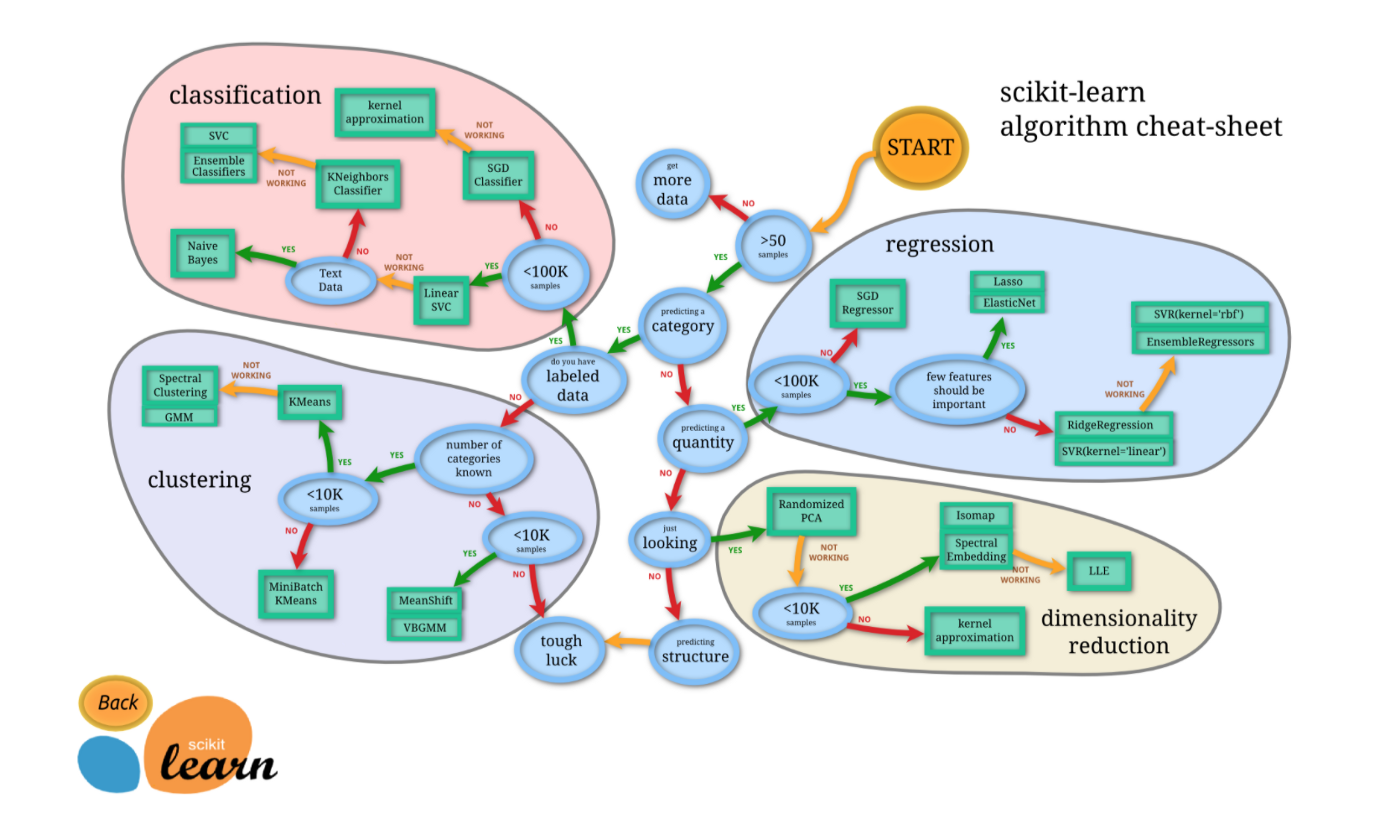
With a vast array of machine problems and techniques, choosing the right estimator, or the equation used to train a machine to solve a problem, is tricky. Luckily, tools such as the scikit above make it more convenient for humans to identify solutions. By identifying the task at hand through a flowchart, we can algorithmically determine the best course of machine action. Maybe one day machines will become so sophisticated that they will be capable of choosing estimators on their own, but until then humans must hone their own problem solving skills before delegating the rest of the work to a machine.
Learn how to choose the right ML algorithm by considering factors like data characteristics, problem type, and performance metrics for optimal results
65e0e1dcb09181168356dc01