lotus labs
AI-Powered Updates Coming Soon to Your Favorite Apps



Slack: SlackGPT
SlackGPT is a new chatbot for Slack that can help users with a variety of tasks, such as finding information, scheduling meetings, and generating creative content. Powered by OpenAI's GPT-3 language model, SlackGPT will help you work smarter, learn faster, and communicate better. Each time you log in, you will be able to quickly get up to speed with one click as the AI technology can summarize all of a channel’s unread messages into a brief summary. SlackGPT also has the ability to automate emails or messages based on the audience further increasing daily productivity. Additionally, with AI assistance built natively into Slack’s message composer and canvas, Slack GPT can also help you tweak your drafts until perfection. With a few clicks, you can create content or adjust the tone at any point in your writing with options to shorten, elaborate, or change the tone.
Grammarly: GrammarlyGO
GrammarlyGO is a new mobile app available for iOS and Android devices that uses AI to help users with grammar, spelling, and punctuation. GrammarlyGO brings the power of generative AI to the Grammarly experience, providing assistance across the digital spaces you write in most. There are a variety of ways to use GrammarlyGO as it can keep track of the context of your writing as well as your preferred writing style while offering suggestions. You can accelerate your writing process by prompting GrammarlyGO with basic instructions to conceive polished drafts. You can simplify rewriting by inputting your written text into GrammarlyGO and letting the app offer different versions of your original ideas. Finally, you can facilitate brainstorming as GrammarlyGO can generate any idea or structure straight to the page you are already on. While users will be able to input 100 prompts per month into GrammarlyGO for free, they will need the premium version for more monthly inputs.
Zoom: ZoomIQ
The purpose of Zoom IQ is to be a smart companion that empowers collaboration and unlocks people’s potential by summarizing chat threads, organizing ideas, drafting content for chats, emails, and whiteboard sessions, and creating meeting agendas. As a result, this AI- add-on has many notable features such as being able to analyze meeting recordings and provide insights into how meetings are being run. This information can then be used to improve meeting performance and productivity. If you have to join a Zoom meeting late, you can simply ask Zoom IQ to summarize what you have missed in real-time and even ask further questions. If you need to create a whiteboard session for your meeting, Zoom IQ can generate it based on text prompts. If you need an additional perspective for a Zoom chat, you can use Zoom IQ to compose messages based on the conversational context. With its new AI innovations, Zoom appears to be poised for further growth.

Discover 3 AI tools that are useful for any professional including those for productivity automation and data analysis
65e0e1dcb09181168356dc07
lotus labs
© 2026 LOTUSLABS All rights reserved.


AI-Powered Updates Coming Soon to Your Favorite Apps
Slack: SlackGPT
SlackGPT is a new chatbot for Slack that can help users with a variety of tasks, such as finding information, scheduling meetings, and generating creative content. Powered by OpenAI's GPT-3 language model, SlackGPT will help you work smarter, learn faster, and communicate better. Each time you log in, you will be able to quickly get up to speed with one click as the AI technology can summarize all of a channel’s unread messages into a brief summary. SlackGPT also has the ability to automate emails or messages based on the audience further increasing daily productivity. Additionally, with AI assistance built natively into Slack’s message composer and canvas, Slack GPT can also help you tweak your drafts until perfection. With a few clicks, you can create content or adjust the tone at any point in your writing with options to shorten, elaborate, or change the tone.
Grammarly: GrammarlyGO
GrammarlyGO is a new mobile app available for iOS and Android devices that uses AI to help users with grammar, spelling, and punctuation. GrammarlyGO brings the power of generative AI to the Grammarly experience, providing assistance across the digital spaces you write in most. There are a variety of ways to use GrammarlyGO as it can keep track of the context of your writing as well as your preferred writing style while offering suggestions. You can accelerate your writing process by prompting GrammarlyGO with basic instructions to conceive polished drafts. You can simplify rewriting by inputting your written text into GrammarlyGO and letting the app offer different versions of your original ideas. Finally, you can facilitate brainstorming as GrammarlyGO can generate any idea or structure straight to the page you are already on. While users will be able to input 100 prompts per month into GrammarlyGO for free, they will need the premium version for more monthly inputs.
Zoom: ZoomIQ
The purpose of Zoom IQ is to be a smart companion that empowers collaboration and unlocks people’s potential by summarizing chat threads, organizing ideas, drafting content for chats, emails, and whiteboard sessions, and creating meeting agendas. As a result, this AI- add-on has many notable features such as being able to analyze meeting recordings and provide insights into how meetings are being run. This information can then be used to improve meeting performance and productivity. If you have to join a Zoom meeting late, you can simply ask Zoom IQ to summarize what you have missed in real-time and even ask further questions. If you need to create a whiteboard session for your meeting, Zoom IQ can generate it based on text prompts. If you need an additional perspective for a Zoom chat, you can use Zoom IQ to compose messages based on the conversational context. With its new AI innovations, Zoom appears to be poised for further growth.
Get ready for AI-powered updates coming soon to your favorite apps with enhanced features smarter recommendations and improved user experiences
65e0e1dcb09181168356dc08
lotus labs
© 2026 LOTUSLABS All rights reserved.

Transforming Clinical Documentation: Building an AI Medical Scribe with LLMs
Picture this: Your typical physician spends more time documenting patient visits than actually providing care. He has to juggle between patients, make notes, review them, and develop a relationship with the patient while other personal things run in the background in his brain.
That's where LLMs and voice technology for medical scribing enter the conversation. Together, they're transforming how clinicians capture patient interactions, offering a seamless way to document while staying present with patients.
Welcome to the future of clinical documentation, where real-time audio transcription meets smart summarization to deliver AI-powered medical scribing. In this blog, we walk through how you can build an AI Medical Scribe using fine-tuned models specific to medical data for speech-to-text and LLMs (Large Language Models) like GPT-4.1 for clinical summarization, patient instructions, and more.
The Current Challenges in Medical Documentation
Time Burden on Healthcare Providers:
Imagine this: for every hour a doctor spends with patients, they spend another hour or maybe more completing documentation. This isn’t some dystopian prediction; it's the current reality in clinics and hospitals around the world. The average physician now dedicates a significant portion of their week to paperwork, amounting to what feels like two full workdays lost to note-taking instead of patient care.
Many physicians routinely stay late to complete their charting, often finishing notes at home during dinner, after hours, and even on weekends. The documentation never ends.
And it's not just about time. It’s also about cognitive overload. Doctors are expected to recall detailed patient conversations while simultaneously navigating proper coding, billing regulations, and legal compliance.
Concerns About Accuracy and Completeness:
Documentation issues aren’t just clerical, they're clinical. When doctors are forced to rush their notes between appointments, critical details get lost. Symptoms may go unrecorded, medication lists become outdated, and treatment plans lack important context.
The mental strain is real. Picture trying to recall every detail from 20+ patient conversations after a draining day. It’s nearly impossible.
Worse still is the looming threat of legal liability. Physicians know that poor or incomplete notes could be used against them in a malpractice case. So they spend additional time obsessively reviewing their documentation, adding to an already heavy burden.
Inconsistency is another major issue. Documentation quality varies drastically from one provider to another, making it hard for care teams to understand a patient’s history, especially during referrals or transitions in care.
Erosion of Doctor-Patient Interaction:
Remember when your doctor looked you in the eye instead of at a screen?
That moment of connection is becoming rare. Today, physicians often double as data entry clerks during consultations, typing as patients talk, desperately trying to capture every detail for the record.
This split attention degrades the patient experience. How can trust be built when it feels like the doctor is more engaged with their keyboard than the person in front of them?
Research shows that patients perceive less empathy from physicians who focus heavily on documentation during visits, and that matters. A strong therapeutic relationship often leads to better outcomes.
The constant interruptions don’t help. Natural conversations are disrupted when doctors need to pause and fill in forms. Some even avoid open-ended questions just to limit the documentation workload.
And patients notice. Many leave appointments feeling rushed, unheard, or unsure whether their concerns were truly addressed.
Rising Burnout Among Medical Professionals:
The burden of documentation isn't just frustrating; it's dangerous.
Physician burnout is now a full-blown crisis, with a significant majority of doctors reporting symptoms. Administrative tasks, especially documentation, are consistently ranked as the top contributor.
The psychological impact is immense. Doctors don't spend a decade training just to become glorified clerks. The disconnect between their desire to heal and the daily grind of paperwork creates profound moral injury.
The consequences are alarming:
- Higher risk of medical errors due to cognitive fatigue.
- Early retirement and career changes, worsening doctor shortages.
- Declining empathy and compassion in clinical care.
Physicians often describe themselves as "data entry specialists" rather than caregivers. The system, as it stands, prioritizes documentation over healing, and it's breaking their spirit.
What Is an AI Medical Scribe?
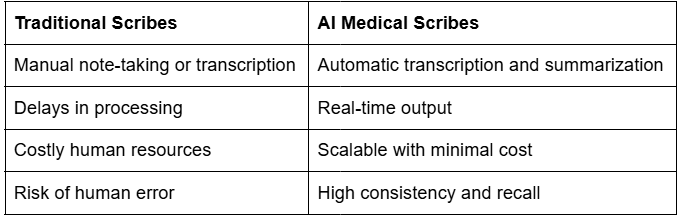
An AI Medical Scribe listens to doctor-patient conversations and automatically generates clinical notes, reducing the time physicians spend on manual documentation.
Traditional vs AI Scribing
Why Use LLMs?
Model for Medical Transcription
LLM specifically trained on medical data is used for a real-time speech-to-text via an API that supports:
- Live audio streams and pre-recorded files
- Speaker diarization (distinguishing doctor vs patient)
- Custom vocabulary tuning for medical terminology
- Low latency and high throughput are great for clinical settings.
LLMs for Summarization & Follow-Up
LLMs like OpenAI's GPT-4.1 can:
- Convert transcripts into structured, customizable summaries
- Extract important medical insights.
- Generate patient to-do lists (e.g., schedule MRI, continue meds, follow diet)
- Format outputs for EHR integration
Together, the Speech-to-text model and an LLM form the perfect pair for hands-free, intelligent clinical documentation.
Key Features of Our AI Medical Scribe
Audio Input:
Supports real-time microphone input or the ability to upload audio files in .mp3 or .wav formats.
Accurate Transcription:
Utilizes a custom medical speech recognition engine to deliver high-accuracy transcriptions optimized for clinical conversations.
Summarization Logic:
Employs a Large Language Model (LLM) to generate structured outputs such as SOAP notes or customized summary formats, depending on clinical requirements.
Patient To-Do Generation:
Automatically creates a clear checklist of follow-up tasks and recommendations to enhance patient compliance and care continuity.
Exportable Reports:
Allows downloading summaries as PDFs and includes future support for integration with Electronic Health Record (EHR) systems.
Real-World Demo: Building the AI Scribe
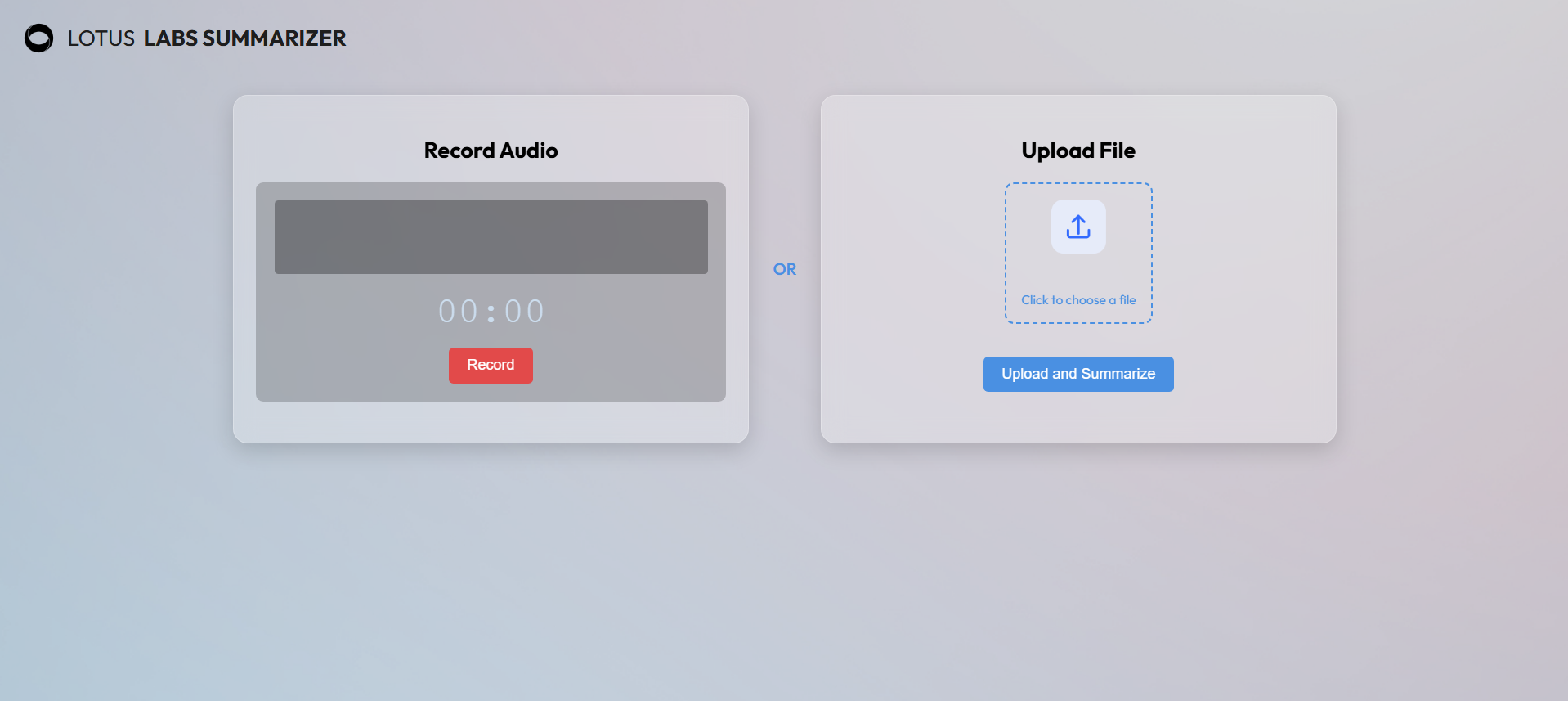
We developed a demo application to demonstrate the capabilities of an AI-powered medical scribe workflow, streamlining the transformation of doctor-patient conversations into structured, actionable documentation.
Tech Stack Overview:
- Frontend: Built using HTML, CSS, JavaScript, allowing for a clean, interactive interface and rapid iteration, ideal for showcasing healthcare workflows.
- Backend: Developed in Python, with integrated APIs for speech-to-text conversion and language generation.
- Storage: Outputs, including transcripts and summaries, are saved locally and can be exported in JSON or PDF formats.
Workflow Breakdown:
- Audio Capture:
Users can either upload a pre-recorded doctor-patient conversation or record one live within the app. - Transcription:
The audio is processed by a speech recognition engine that returns a diarized (speaker-separated), clean transcript, ensuring clarity and preserving conversational flow. - Prompt Engineering and Summarization:
The transcript is carefully formatted and enriched with context before being passed to a language model. Special attention was paid to prompt design, balancing brevity with completeness to consistently produce high-quality summaries. The prompts guide the model to generate SOAP-formatted notes (Subjective, Objective, Assessment, Plan), which align with standard clinical documentation practices. - Follow-up Extraction:
In addition to clinical summaries, the model is prompted to identify and extract clear, actionable patient follow-up tasks, forming a checklist that enhances post-visit patient compliance. - Export:
Final outputs, including the transcript, summary, and checklist, are available for download as a PDF or stored as a JSON for further integration and analysis.
Compliance and Privacy Considerations
In any clinical tech solution, privacy and compliance are non-negotiable.
HIPAA Compliance:
- OpenAI and other LLM firms offer enterprise plans with HIPAA-compliant environments.
- Encryption during audio transmission and storage
- Patient consent must be explicitly captured before recording.
Data Security:
- Audio data can be tokenized or anonymized
- Local or on-prem deployment is possible for sensitive environments.
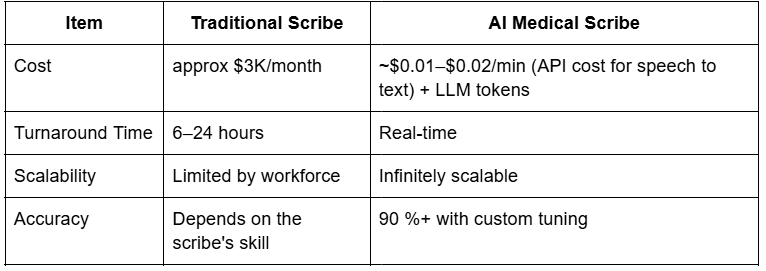
Cost-Benefit Analysis
Future of AI in Clinical Workflows
AI medical scribes are just the beginning. Here’s what’s coming next:
- EHR Integration: Direct API sync with Epic, Cerner, etc.
- Multilingual Transcription: Serving global and rural populations
- Real-time Decision Support: LLMs suggesting diagnoses, alerts
- Voice-Based Interactions: Doctors dictating and querying systems hands-free
Challenges to Consider
- Medical accuracy: Misinterpreted terms can lead to dangerous summaries
- Accent/dialect issues in STT models
- Patient trust: Adoption may take time
- Internet dependency for real-time use cases
These challenges can be mitigated with hybrid systems, offline fallback models, and human-in-the-loop verification.
AI Medical Scribes represent a transformative shift in how healthcare providers manage documentation. By combining a custom model’s fast, accurate transcription with the intelligence of LLMs, clinics and hospitals can drastically improve efficiency, reduce costs, and enhance patient care.
The demo we built proves how accessible and scalable this technology can be. And we’re just scratching the surface.
To work on similar and various other AI use cases, connect with us at
https://www.lotuslabs.ai/
To work on computer vision use cases, get to know our product Padme
https://www.padme.ai/
Transforming Clinical Documentation: Building an AI Medical Scribe with Deepgram and LLMs
68594b6f4121fb2c603fdefe