lotus labs
AI-Powered Updates Coming Soon to Your Favorite Apps



Slack: SlackGPT
SlackGPT is a new chatbot for Slack that can help users with a variety of tasks, such as finding information, scheduling meetings, and generating creative content. Powered by OpenAI's GPT-3 language model, SlackGPT will help you work smarter, learn faster, and communicate better. Each time you log in, you will be able to quickly get up to speed with one click as the AI technology can summarize all of a channel’s unread messages into a brief summary. SlackGPT also has the ability to automate emails or messages based on the audience further increasing daily productivity. Additionally, with AI assistance built natively into Slack’s message composer and canvas, Slack GPT can also help you tweak your drafts until perfection. With a few clicks, you can create content or adjust the tone at any point in your writing with options to shorten, elaborate, or change the tone.
Grammarly: GrammarlyGO
GrammarlyGO is a new mobile app available for iOS and Android devices that uses AI to help users with grammar, spelling, and punctuation. GrammarlyGO brings the power of generative AI to the Grammarly experience, providing assistance across the digital spaces you write in most. There are a variety of ways to use GrammarlyGO as it can keep track of the context of your writing as well as your preferred writing style while offering suggestions. You can accelerate your writing process by prompting GrammarlyGO with basic instructions to conceive polished drafts. You can simplify rewriting by inputting your written text into GrammarlyGO and letting the app offer different versions of your original ideas. Finally, you can facilitate brainstorming as GrammarlyGO can generate any idea or structure straight to the page you are already on. While users will be able to input 100 prompts per month into GrammarlyGO for free, they will need the premium version for more monthly inputs.
Zoom: ZoomIQ
The purpose of Zoom IQ is to be a smart companion that empowers collaboration and unlocks people’s potential by summarizing chat threads, organizing ideas, drafting content for chats, emails, and whiteboard sessions, and creating meeting agendas. As a result, this AI- add-on has many notable features such as being able to analyze meeting recordings and provide insights into how meetings are being run. This information can then be used to improve meeting performance and productivity. If you have to join a Zoom meeting late, you can simply ask Zoom IQ to summarize what you have missed in real-time and even ask further questions. If you need to create a whiteboard session for your meeting, Zoom IQ can generate it based on text prompts. If you need an additional perspective for a Zoom chat, you can use Zoom IQ to compose messages based on the conversational context. With its new AI innovations, Zoom appears to be poised for further growth.

Discover 3 AI tools that are useful for any professional including those for productivity automation and data analysis
65e0e1dcb09181168356dc07
lotus labs
© 2026 LOTUSLABS All rights reserved.


AI-Powered Updates Coming Soon to Your Favorite Apps
Slack: SlackGPT
SlackGPT is a new chatbot for Slack that can help users with a variety of tasks, such as finding information, scheduling meetings, and generating creative content. Powered by OpenAI's GPT-3 language model, SlackGPT will help you work smarter, learn faster, and communicate better. Each time you log in, you will be able to quickly get up to speed with one click as the AI technology can summarize all of a channel’s unread messages into a brief summary. SlackGPT also has the ability to automate emails or messages based on the audience further increasing daily productivity. Additionally, with AI assistance built natively into Slack’s message composer and canvas, Slack GPT can also help you tweak your drafts until perfection. With a few clicks, you can create content or adjust the tone at any point in your writing with options to shorten, elaborate, or change the tone.
Grammarly: GrammarlyGO
GrammarlyGO is a new mobile app available for iOS and Android devices that uses AI to help users with grammar, spelling, and punctuation. GrammarlyGO brings the power of generative AI to the Grammarly experience, providing assistance across the digital spaces you write in most. There are a variety of ways to use GrammarlyGO as it can keep track of the context of your writing as well as your preferred writing style while offering suggestions. You can accelerate your writing process by prompting GrammarlyGO with basic instructions to conceive polished drafts. You can simplify rewriting by inputting your written text into GrammarlyGO and letting the app offer different versions of your original ideas. Finally, you can facilitate brainstorming as GrammarlyGO can generate any idea or structure straight to the page you are already on. While users will be able to input 100 prompts per month into GrammarlyGO for free, they will need the premium version for more monthly inputs.
Zoom: ZoomIQ
The purpose of Zoom IQ is to be a smart companion that empowers collaboration and unlocks people’s potential by summarizing chat threads, organizing ideas, drafting content for chats, emails, and whiteboard sessions, and creating meeting agendas. As a result, this AI- add-on has many notable features such as being able to analyze meeting recordings and provide insights into how meetings are being run. This information can then be used to improve meeting performance and productivity. If you have to join a Zoom meeting late, you can simply ask Zoom IQ to summarize what you have missed in real-time and even ask further questions. If you need to create a whiteboard session for your meeting, Zoom IQ can generate it based on text prompts. If you need an additional perspective for a Zoom chat, you can use Zoom IQ to compose messages based on the conversational context. With its new AI innovations, Zoom appears to be poised for further growth.
Get ready for AI-powered updates coming soon to your favorite apps with enhanced features smarter recommendations and improved user experiences
65e0e1dcb09181168356dc08
lotus labs
© 2026 LOTUSLABS All rights reserved.

Why “Chat with Your Data” Usually Disappoints — and How to Make It Enterprise-Grade
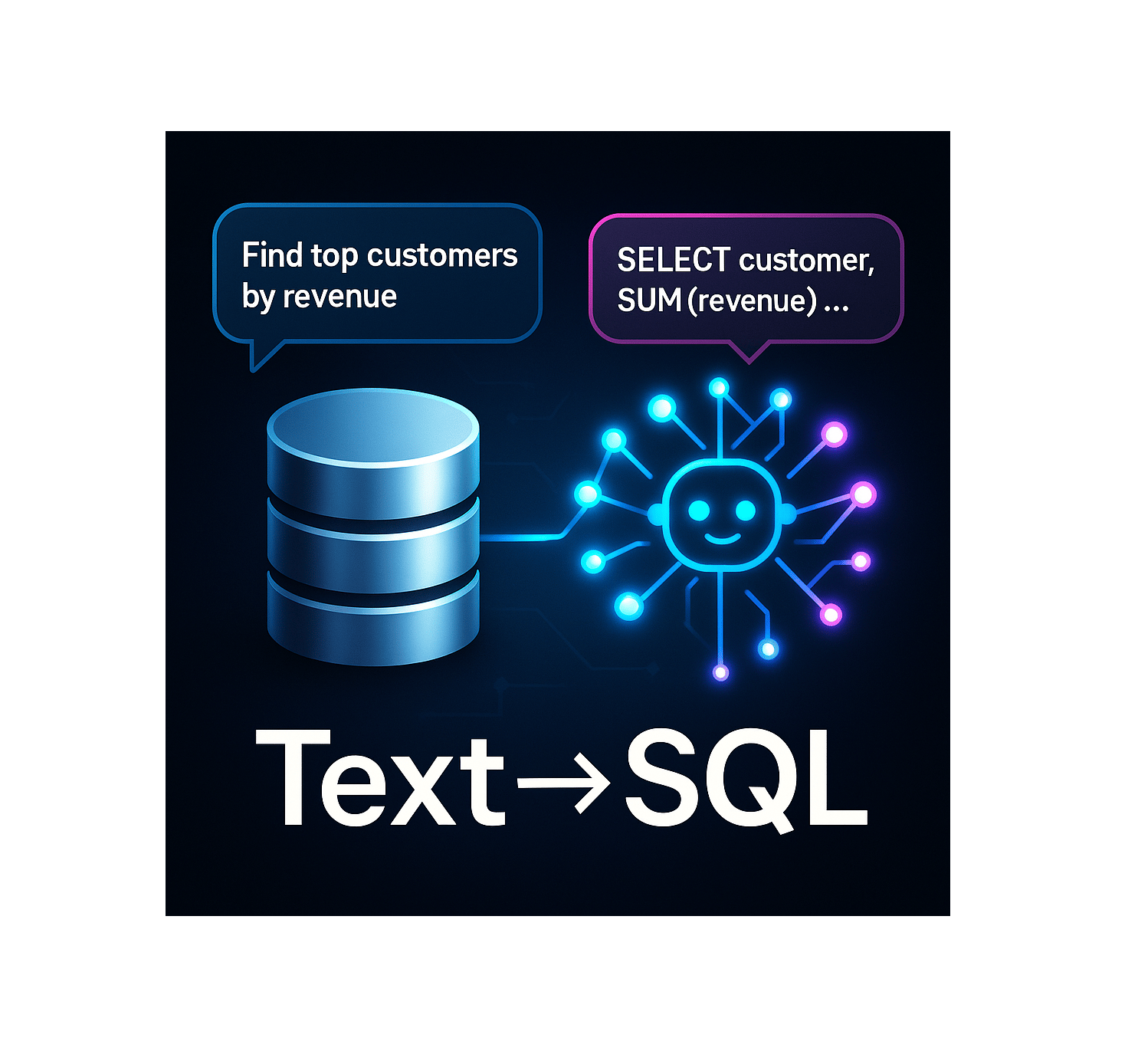
Most organizations already have the data. What they lack is reliable, fast, and accountable access to it. Ticket queues, stale dashboards, schema sprawl, and ambiguous ask-to-SQL translation conspire to slow decisions and erode trust. This essay distills what we’ve learned from shipping production text-to-SQL across hundreds of tables and thousands of columns, and connects those lessons to what top papers actually found.
Typical Points of Failure
1) Natural language is ambiguous; enterprise schemas are not
The leap from “orders by product type last quarter in EMEA” to the right facts, date roles, and product grain is precisely the “schema generalization” problem that benchmark designers targeted. Spider deliberately forces models to generalize to unseen databases, making this pain explicit. As the authors put it, Spider is “a complex and cross-domain… task so that different… databases appear in train and test sets.”¹
RAT-SQL showed that explicit, relation-aware schema linking matters. Its core observation: “any text-to-SQL parsing model must encode the schema” so the decoder can select correct tables/columns under domain shift.² (This is exactly the day-to-day challenge in warehouses with hundreds of tables.)
2) Models happily emit invalid or un-executable SQL
A line of work tackles this with decoding constraints and execution feedback. PICARD “helps to find valid output sequences by rejecting inadmissible tokens at each decoding step,” taking T5-style models from “passable” to state-of-the-art on Spider/CoSQL.³ (Concretely: it parses as it decodes, and simply refuses illegal next tokens.)
Execution-guided decoding (EG) goes after semantic errors: partially executes candidates and prunes ones that fail (wrong types, broken joins). Wang et al. reported consistent gains across datasets by “conditioning on the execution of partially generated” programs.⁴
3) Benchmark scores overstate production reliability
Two threads are crucial here:
- Robustness under perturbations. Dr.Spider introduced 17 perturbation sets to stress synonyms, column swaps, and other realistic changes; many systems degraded significantly when surface forms shifted.⁵
- Data-model drift and business semantics. A 2025 EDBT study argued that “systematic exploration of robustness towards different data models in a real-world… scenario is missing,” then evaluated multi-year deployments, highlighting brittleness when schemas evolve.⁶
4) Evaluation itself is tricky—and sometimes misleading
A careful review contrasts “exact-set match” with “execution accuracy,” noting that equivalence testing is hard and that exact-match can penalize benign rewrites while execution accuracy can pass wrong-but-lucky queries.⁷ A practical takeaway: measure more than one metric and add operational checks (e.g., date-role consistency, distinct-count grain).
5) Security and governance cannot live in prompts
In production, row-level security (RLS) belongs in the database. SQL Server enforces this via predicate functions and security policies (“FILTER” vs “BLOCK” predicates), so access rules apply universally to every ad-hoc query.⁸ ⁹ ¹⁰ (Community write-ups also note caveats: cost and potential bypasses if misconfigured.)¹¹
What Works in Production (and why)
A. Router-Enhanced RAG to tame schema sprawl
Agentic systems that classify intent (e.g., internet vs reseller sales; default order date), then bias retrieval toward a minimal anchor set (core fact + key dims) consistently reduce hallucinations and wrong table picks. This operationalizes RAT-SQL’s insight—link to the right schema elements—but achieves it with retrieval and intelligent routing instead of a single monolithic encoder (e.g., Zhang et al., 2025)..² ¹⁴
B. Constrain generation, then use the database as a judge
Combine grammar-constrained generation—PICARD-style on open-weight deployments with token-level control (e.g., logit masking/grammars) or provider “structured outputs” on hosted models—with execution-guided decoding to catch most syntax errors and many semantic errors early. In practice, this pair cuts a wide class of invalid or nonsensical outputs before they’re persisted or consumed by downstream systems (e.g., vLLM’s structured-output backends for guided decoding).³ ⁴ ¹⁵
C. Bake in domain-specific rules of the road
Most downstream errors are business errors: wrong date roles (ship vs order), broken grouping grain (counting distinct orders at SKU while labeling at family), mis-attributing country by customer domicile instead of sales territory, etc. Surveys from 2024–2025 call for lifecycle-level evaluation and error taxonomies that explicitly target these categories.¹² ¹³ Operationalize them as post-hoc checks with hard failures and human-readable reasons.
D. Treat drift as a first-class surface
When new columns/tables appear, regenerate embeddings and refresh low-cardinality value catalogs (enums, status codes). The EDBT study’s central point is that data-model robustness can only be earned by tracking and reacting to change.⁶
E. Observe everything
Log routes, prompts, SQL, and masked row samples; track token/latency budgets; and attach compact explanations to each answer. This isn’t “nice to have” — it’s how you debug, govern, and build trust.
A Brief Note on Petalytics
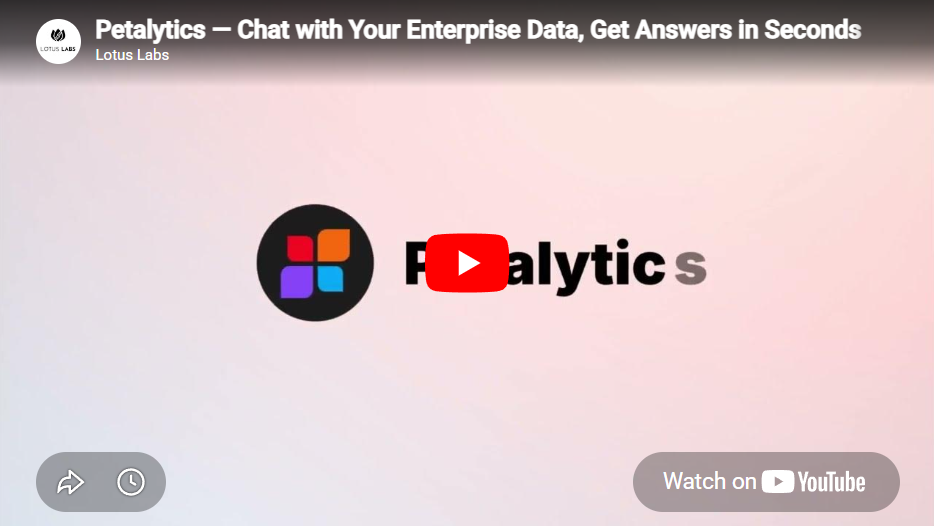
Petalytics (Request Early Access) implements the blueprint above so stakeholders can actually use it:
https://www.youtube.com/watch?v=6a2PWyvlw34
- An agentic, cohesive, multi-layer pipeline where each component has a clear purpose, fits the whole, receives tailored context, and reasons over your business semantics and database schema.
- An intent router induces a hierarchical taxonomy over the user prompt, then conditionally steers retrieval so that category-conditioned RAG orchestrates context injection across the workflow.
- Guardrails end-to-end. Decoding is constrained (PICARD-style on open-weight deployments or schema-validated structured outputs on hosted models); candidates are screened via execution; post-hoc business checks enforce date-role and grain consistency; suspicious SQL is declined rather than executed.
- Scale-aware context. Designed for hundreds of tables / thousands of columns; context packs refresh as schemas evolve.
- Security where it belongs. We rely on database-native RLS (FILTER/BLOCK policies).
- Explainability. Every answer includes a crisp scope and assumptions (channel, date role, product grain) so business users can trust and challenge results.
Implementation Checklist (production-oriented)
- Codify semantics once. Define canonical meanings (“orders,” “product type,” “GM%”) and default date roles; store them in retrievable docs the router can bias toward. (This is the practical side of schema-linking.)²
- Constrain + execute. Use PICARD-style decoding or structured-output constraints for syntax, then execution guidance (plan/dry-run, capped probes) for semantics; sandbox and cap runtime.³ ⁴
- Enforce business grain. Add automated checks for distinct counts at the correct grain; reject queries that mix SKU-level counts with family-level labels.¹² ⁷
- Instrument drift. Watch DDL events; regenerate embeddings and value catalogs as schemas evolve; alert when docs are stale.⁶
- Push RLS into the database. Use SQL Server security policies (FILTER/BLOCK) and predicate functions; don’t reinvent access control in prompts.⁸ ⁹
- Evaluate like an operator. Track exact-match and execution accuracy, but also operational KPIs: time-to-first-answer, correction rate, and reasoned declines (guardrails doing their job).⁵ ⁷ ¹²
References
- Yu, Tao, et al. “Spider: A Large-Scale Human-Labeled Dataset for Complex and Cross-Domain Semantic Parsing and Text-to-SQL Task.” Proceedings of EMNLP, 2018. https://aclanthology.org/D18-1425/ (accessed September 5, 2025).
- Wang, Bailin, et al. “RAT-SQL: Relation-Aware Schema Encoding and Linking for Text-to-SQL Parsers.” Proceedings of ACL, 2020. https://aclanthology.org/2020.acl-main.677.pdf (accessed September 5, 2025).
- Scholak, Torsten, Nathan Schucher, and Dzmitry Bahdanau. “PICARD: Parsing Incrementally for Constrained Auto-Regressive Decoding from Language Models.” Proceedings of EMNLP, 2021. https://aclanthology.org/2021.emnlp-main.779/ (accessed September 5, 2025).
- Wang, Chenglong, et al. “Robust Text-to-SQL Generation with Execution-Guided Decoding.” arXiv preprint, 2018. https://arxiv.org/abs/1807.03100 (accessed September 5, 2025).
- Chang, Shuaichen, et al. “Dr.Spider: A Diagnostic Evaluation Benchmark towards Text-to-SQL Robustness.” arXiv preprint, 2023. https://arxiv.org/abs/2301.08881 (accessed September 5, 2025).
- Fürst, Josef, et al. “Evaluating the Data Model Robustness of Text-to-SQL Systems in Practice.” Proceedings of EDBT, 2025. https://openproceedings.org/2025/conf/edbt/paper-18.pdf (accessed September 5, 2025).
- Pourreza, Mohammad, et al. “On the Evaluation of Text-to-SQL Systems: Exact-Match versus Execution Accuracy.” arXiv preprint, 2023. https://arxiv.org/pdf/2310.18538 (accessed September 5, 2025).
- Microsoft. “Row-Level Security (RLS) — SQL Server.” Microsoft Learn Documentation, updated November 22, 2024. https://learn.microsoft.com/en-us/sql/relational-databases/security/row-level-security (accessed September 5, 2025).
- Microsoft. “CREATE SECURITY POLICY (Transact-SQL).” Microsoft Learn Documentation, updated November 22, 2024. https://learn.microsoft.com/en-us/sql/t-sql/statements/create-security-policy-transact-sql (accessed September 5, 2025).
- Microsoft. “ALTER SECURITY POLICY (Transact-SQL).” Microsoft Learn Documentation, updated July 9, 2025. https://learn.microsoft.com/en-us/sql/t-sql/statements/alter-security-policy-transact-sql (accessed September 5, 2025).
- Redgate. “SQL Server Row Level Security Deep Dive (Attacks and Caveats).” Simple Talk, September 25, 2023. https://www.red-gate.com/simple-talk/blogs/sql-server-row-level-security-deep-dive-part-5-rls-attacks/ (accessed September 5, 2025).
- Li, Guoliang, et al. “A Survey of Text-to-SQL in the Era of LLMs.” IEEE Transactions on Knowledge and Data Engineering (early access), 2025. https://dbgroup.cs.tsinghua.edu.cn/ligl/papers/TKDE25-NL2SQL.pdf (accessed September 5, 2025).
- Liu, Zhi, et al. “A Survey of LLM-Based Text-to-SQL.” arXiv preprint, 2025. https://arxiv.org/html/2406.08426v4 (accessed September 5, 2025).
- Zhang, Jiarui, Xiangyu Liu, Yong Hu, Chaoyue Niu, Fan Wu, and Guihai Chen. “Query Routing for Retrieval-Augmented Language Models.” arXiv preprint, 2025. https://arxiv.org/abs/2505.23052 (accessed September 5, 2025).
- vLLM Contributors. “Structured Outputs — vLLM.” vLLM Documentation. docs.vllm.ai (accessed September 8, 2025).
Why “Chat with Your Data” Usually Disappoints — and How to Make It Enterprise-Grade: Most organizations already have the data. What they lack is reliable, fast, and accountable access to it. Ticket queues, stale dashboards, schema sprawl, and ambiguous ask-to-SQL translation conspire to slow decisions and erode trust. This essay distills what we’ve learned from shipping production text-to-SQL across hundreds of tables and thousands of columns, and connects those lessons to what top papers actually found.
68dd2dab116cff845b679576